Showing posts with label Music Review. Show all posts

Monday, 22 January 2018

A Look Back At: Ghostface Killah - Sour Soul

orangetrain


As a solo artist Ghostface has two certified classics in Ironman and Supreme Clientele, and fans will hotly debate Fishscale. On the most electrifying track on Fishscale, ‘The Champ’, the intro skit taunts Starks, “He’s hungry. You ain’t been hungry since Supreme Clientele.” What followed was 4 minutes of boasts, knowledge and punchlines for the strongest lyrical performance from Starks since Supreme Clientele. He channeled the stream-of-consciousness playful mess that made Supreme Clientele so brilliant – “Who want to battle the Don?/I'm James Bond in the Octagon with two razors/Bet cha'all didn't know I had a fake arm/I lost it” – only a prime Ghostface Killah can get away with bars that weird and still make them sound so good.

On Sour Soul, this wild Ghostface, the “bulldozer with a wrecking ball attached” that helped revive both the Wu Tang in 2000 and his own solo career in 2005, was nowhere to be seen. Thus what makes Sour Soul so deserving of another look, of a reappraisal, is that it was Ghostface’s first album in a career defined by his ability to shred the mic to pieces, where he was almost gentle in his delivery. It’s a frankly unique rough diamond in a career full of jewels. It doesn’t rely on his remarkable storytelling ability, it doesn’t have the mic destroying flow, the modernist stream of consciousness ideas. It’s a muted album with muted production to match.

Even the album cover is muted. It’s a far cry from the posturing of Ironman, Bulletproof Wallets and Fishscale, the focus of Supreme Clientele, or the pop-culture inspirations that grace Wu-Massacre and Twelve Reasons To Die. Ghost’s face is obscured by the American flag. It falls atop his head like the sweaty towel of a boxer after a twelve round fight. His eyes gaze coldly at something unknown beyond the frame. The black and white palette helps to shroud the album cover in mystery. The image looks more appropriate for a polemical comeback album by Chuck D, Mos Def or Ice Cube. It does not look like the album cover for one of the greatest gangster rapper’s of all time.

The intro track ‘Mono’ glides into play. It’s a jazzy 58 second sleep tone setter, with sparse drums and a soothing bass line. This is a far cry from the legendary opening skit of Ironman.

“I got a message for Smoky?”
 “What is it?”
 “You ain’t Smoky it ain’t yo motherfucking message”
  “Motherfucker I said gimme the message”

The album doesn’t explode into life like Ghost’s previous efforts. This does not have the boundless energy that made Supreme Clientele so memorable. The titular track ‘Sour Soul’, the track that Mono fades into, opens with these lines: “Yo, cleanse me, clean me of my sour soul”. It’s the imagery of rebirth, Ghost yearns for a spiritual cleansing. Yet it’s just that: a yearning. It does not yield any sweet fruits for Ghostface. The content of the song that follows is classical Ghost, but with this maturer delivery – his flow is reminiscent of contemporaries Ka and Roc Marciano – New York is coming full circle, the rebirth is taking place.

Every time the album seems like it’s about to burst into a new gear, BadBadNotGood put on the breaks. They indulge in interludes like “Stark’s Reality”. Tony will spit a vicious verse or two and then take a breather. Ghost is indulging himself. On the title track Ghost ends the song stating: “Yeah, I got my swagger back and all that”. In previous albums Ghost’s swagger came from his uncanny eye for storytelling details – the ‘king tut’ piece from motherless child – or from his relentless approach to rhyming. He was an elite craftsman and he wanted to show it. On Sour Soul, for the first time in his career, Ghost is happy to step back and let the band take centre stage – it’s a whole new swagger.

The cast of supporting characters (DOOM, Danny Brown, Tree, Elzhi) make up a quartet of (relatively) elder rap statesman. This isn’t an album for the young rapper, it’s for the refined hip hop head. There’s a reluctancy in Ghost’s tone when discussing ‘pimping’, something he used to do with a searing misogynistic passion, and there are nuggets of political knowledge buried in every song. Tree’s verse on Street Knowledge is emblematic of the very title – detailing snippets of his life growing up in Chicago. On Ray Gun, another DOOMSTARKS collaboration to pluck at the heartstrings, Ghost describes, “Me and DOOM headed down to the range”. I’m sure he’s not describing the golf club, but in light of 50 Cent’s comments on 4:44 one has to wonder whether Ghost was pre-empting “Dad Rap”?

The tone that BBNG brings throughout the album in their gentle bass lines, the scattering of a brush on the cymbals and the subtle piano notes conjures an image of a late night jazz club performance. Ghost the forgotten MC, once a club legend, playing to a room that dwindles as the night runs on. Yet, there’s still some magic to be found in there. Those that stick around with the weary warrior will be rewarded for their efforts. They will be fed eternal wisdom; sweet food for the Sour Soul.

Food:

I used to rob and steal, now I make food for thought
Fresh like the air you snort
I drop jewels, little nuggets of wisdom
Seeds that keep growing
Paying my debts to society, so no more owing
Now it's showing and proving, keep the body moving
Exercising the mind is scientifically proven
To increase your life line, strengthen your heart
Eat fish, that brain food will get you smart
Yoga, deep medicational tactics
You no good then just practice, cause practise makes perfect
Stop burying your lies and bring the truth to the surface
Money is the root to all evil, that cash rule
Will have you out there looking like a damn fool
That's the devil's bait, the all mighty dollartry
Will have your mind fooled by technology
Make the right choice, no need for an apology


Them light as the sun, the sun's the father
The father is the man on Earth, we try harder
To teach one, preach one
Just acknowledge the wisdom
Can't figure right from wrong, it's a tough decision
My vision is light, some come to me when yours black out
Follow the footprints as I lay the tracks out
He's a righteous God, I want the best for mankind
Navigate through this war without blowing a landmine
My light shines from the east my brother
Verbally I spit, I'm a beast my brother
March through the blackness, search for the ray of lights
Don't walk bare footed through the grass
Cause that's where the snake strikes
Protect ya neck, evil lurks in the shadows
Darkness is best where the Devil wins battles
The weak fall victim, the strong sound diligent
Guerilla, we gullible but manage to stay militant
Super stars, our ego is so top billin' it
Follow me son and I'll show you how I'm killin' it
These wolves is vicious, assigned to danger
The changer, I'm 'bout to pull you all through a chamber


Monday, 21 August 2017

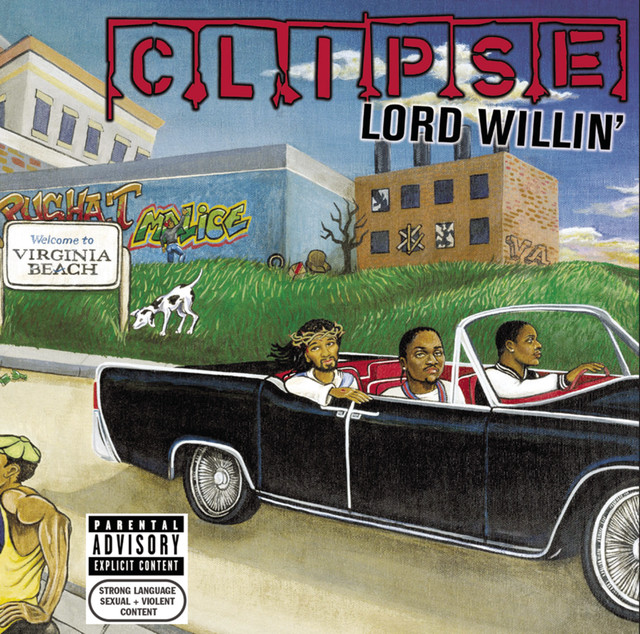
A Look Back At: Clipse - Lord Willin'

orangetrain

Sometimes an easy way to understand an artists progression is through their album artwork. In two years and three albums 2Pac went from restrained and reflective on the cover of Me Against the World; brooding and proud on All Eyez On Me; and strung from a cross, martyred on his posthumous album The Don Killuminati: The 7 Day Theory. It’s an ice-clear example of the artistic and personal progression Pac rapidly underwent in this space of time, reflecting the searing highs and lows his life bounced between, before his tragic death. 

Another ice-clear example of artistic progression and change as reflected in their artwork is Virginia’s favourite brother-rapper duo Clipse, who 15 years ago released their classic debut Lord Willin’. The hand drawn, highly stylised cover is reminiscent of Snoop Dogg’s classic Doggystyle, it exudes cockiness and swagger with Pusha and Malice riding in a Cadillac with Jesus in the backseat. In the background a sign proudly displays their hometown, Virginia Beach – a prominent theme on the album - , as well as some hints towards the social realities of the area, with the two brothers contrasted against the dilapidated buildings behind them. It’s a far cry from the dead-eyed stares, crowned in front of a wall of money with nothing but an oven and a stove pot, that defines their second classic album Hell Hath No Fury. The music of Lord Willin’ is a far cry from HHNF as well, it’s the swagger and lyrical style of Jay-Z and Biggie with a Southern twist, compared to HHNF’s Prodigy and Scarface imbued violence and paranoia. It’s an album with a youthful vigour, without another four years of industry bullshit to weigh them down, without the encroaching religious conscience of Malice and without the even further encroaching fear of the DEA. 

This sense of a youthful playfulness is emblematised perfectly by The Neptunes production, which is full of playful trumpet loops, their signature piercing drums, soulful samples, Pharell’s infectious hooks and funky bass lines– it’s music to dance to; it’s hard not to find yourself grooving to Grindin’, Young Boy or Ma, I Don’t Love Her without ever planning to. For an album whose predominant theme is selling coke, it’s a roaring testament to the timeless quality of The Neptunes that Clipse were able to stretch across genre appeal – Justin Timberlake’s Grammy nominated Like I Love You being the defining moment of this. Some beats feel a little dated now, FamLay Freestyle and I’m Not You are weak moments, the heaviness of the electronic influence leaving little to be desired, but they’re not helped by consistently weak features throughout. If the album suffers from any weak points it is the features, that lack the wittiness of Pusha and Malice, and as such just feel like they’re taking up space that one of the two MCs could better fill on their own. The astonishing skill of Clipse lies in the perfect balance between Pusha and Malice, who mirror and work off of each other so perfectly that other MCs tend to feel like they’re spoiling the broth. 

On Young Boy Pusha and Malice share memories of growing up in Virginia, practicing “gangsta leans” at thirteen, witnessing coke being cooked at four, how their grandma was a woman not to be messed with. For a Conservative right-wing pundit, the stories told might be a horror story, the racist terrors of growing up poor and black. For Clipse, with the help of The Neptunes’ up tempo beat, these are fond memories, touchstones of their youth – perhaps not a ‘normal’ youth, but theirs nonetheless. On When the Last Time the boys boast about their exploits with women, Malice declaring “club nights…one of the reasons I love life” and Pusha ending the song defiantly – “I’m a winner, man”. Pusha declares himself a king in two games at one point on the album, and the sentiment rings true. After nearly a decade of record label struggle, these two brothers would catapult themselves to commercial and critical success, and it wouldn’t even be their only source of income (allegedly). If the album perhaps lacks a depth and variety of content, it’s difficult to hold it against them too much – Clipse came out the gates with a celebration lap; the confidence and delivery in their own self-worth is infectious, you can’t help but like them. 

Those dilapidated buildings that point to a degree of social realism are lightly alluded to on the track Virginia, which acts in a similar vein to the palate cleansing Murder Was Tha Case on Snoop’s classic debut. The hook reveals a bleak lack of opportunity in the community, Pusha bluntly explaining that “I’m from Virginia, where ain’t shit to do but cook”. Pusha seems to straddle the line between confidence and insecurity on the track, “Lost it all, from lives to love/But my faith and money helped me rise above”. The lifestyle that he owes so much of his success to, and so much of his confidence and swagger on the album, slowly starts to crack before the listeners eyes. Yet, Pusha and Malice are always in strict control of how much of their inner self they wish to reveal. The line, “I miss you Shampoo, We miss you Shampoo” offers a glimpse of emotional honesty otherwise absent on the album, before Pusha snatches it away with his wry sense of humour by following it up with “And your grams too…”. Malice’s verse similarly is slightly more autobiographical than elsewhere on the album, but he pulls back even harder when the armour starts to slip – “what I look like spending my nights in jail,/ I could never be a thug they don’t dress this well”. We can forgive him though, because he ends his verse with two of the hardest bars ever spit. In a month where various fascist and neo-Nazi groups have rallied against the removal of Confederate monuments, Malice offers a wonderfully ironic ode to the racist history of the American South. If you don’t know it, go and listen now. 

Lord Willin’ is an interesting album on reflection. It’s full of witty punchlines, clever metaphors, hard bars and braggadocio delivery, and The Neptunes offer a wonderful contrast with their upbeat, funky and soulful production playing off against their lyrical content. At times the album can feel a little sparse on content, that ferociousness they unleash on HHNF is still waiting to boil over, and their structure and penmanship still has a way to go. But what HHNF has in its unrivalled lyricism and thematic coherence, Lord Willin’ has in its Souther swagger, its gangsta lean that leaves you with a smile on your face and a tap in your step when you throw the album on and take a trip down memory lane. Each Clipse album, and each Pusha and Malice solo project, operates within a unique space in time – the two brothers wear there emotional state on their sleeves; with Lord Willin’ they were on top of the world – and sometimes happiness, confidence, swagger and so on is good, sometimes it can imbue its readers with this state of mind too. In the troubled waters that lie ahead for 2017, I think we could all do with a little more confidence and swagger. 


Wednesday, 19 July 2017

A Look Back At: Cousin Stizz – Monda

orangetrain


One week after Stizz released his third mixtape, One Night Only, I’ve decided it’s a perfect time to launch a new series, ‘A Look Back At’, and offer a retrospective on his warmly received 2016 effort Monda… I think there’s a reason I’m not a smash hit hip-hop writer.

Hailing from Boston, Stizz’s sophomore effort plays more like a late 90s regional Houston album than the work of an East Coast street star in the 21st century. The Houston comparison is perhaps not recognisable on a first glance, after all, the production is light years from that sound, dominated by producers Lee Rich, Tee Watt and M. Ali, and Dumdrumz, but it is rooted in the sensibilities of Southern trap music, with Memphis drums alongside a more recognisable contemporary Atlanta sound. Where the Houston comparison seems apt is in the structure of the album, alongside the lyrical style of Stizz, combined with his phenomenally relaxed flow that sounds as smooth as any other rapper out today.
       The title Monda is a reference to a late friend of Stizz’s, who sadly passed from cancer a few months before the release of the album. The cover of the album sees Stizz reflecting on his friend, who he has permanently memorialised with a tattoo on his left arm. It is this theme of reflection and loss that permeates the whole album, with Stizz’s new found success and the speed of change in his life, going like “500 horses”, creating the moment to remember the struggles and successes on his road to fame. The opening track sets this tone, Stizz reminding himself to not “take for granted anything I’m making while I’m here”, remembering how he used to stare at the “mountaintops” from the very bottom, a clear indicator for how far he knows he has come already. There is an understanding from Stizz also that even if he desired to leave the street lifestyle behind him entirely, he cannot simply cut the ties to his past. Stizz explains that “I still get calls like, “Bro, whatshisname just got killed””, and on ‘500 Horses’, the opening bars see Stizz’s first action when returning home to visit the “cemetery” and pay respect for his lost friends.
The past is not simply a painful reminder for Stizz, however, who raps that, “Yeah we struggle, but I kept my smile intact” and “Through the nonsense we was able to enjoy life through the process”. Stizz, from a rap perspective, is carrying the city of Boston on his back, and he will not shrug that responsibility off having found success. Growing up in Boston may have been difficult, but these difficulties are etched into his skin, they are not something Stizz shies away from, instead he embraces his past as defining the man he is today. The hook for ‘Big Fella’, “Young nigga grew into the big fella” pairs nicely with this couplet from the first verse, “Talkin’ bout a struggle you don’t know bout/That’s why it’s so easy for me to get these flows out”, to reflect the importance of his youth on his contemporary success.
In this pride Stizz displays towards his city, his past and the journey he has come on the comparison to 90s Houston rappers becomes apparent. In particular, Stizz displays a similar lyrical honesty to Fat Pat, both proudly representing the cities they come from, and the nuances of growing up within these places. Further still, Stizz shares Fat Pat’s characteristic buttery smooth flow and exceptional hook writing ability. Although he does not display the singing-rapping style prominent in the Screwed-Up-Clique, Stizz shares their DNA of authentic, sparse bars that paint a vivid picture of growing up poor and black in an urban environment, of beginning to achieve his “Ghetto Dreams”. The ability to jump between past and present, braggadocio and humbleness, and to weave between the two within words, lines and verses seems heavily inspired, again, by the Houston rap scene. UGK, Scarface, Bushwick Bill, 8Ball & MJG and the SUC all had an amazing ability to make you understand the conflicting realities in their lives, the sharp juxtapositions between abject poverty and grandiose success, between serious tragedy and deep joy, between humility and swagger. They made uncompromising hip-hop for their own communities, and in turn they helped to put both Houston and the South on hip-hop radars for ever.
     Today Houston is an established rap scene, with legends like Scarface and Z-Ro continuing to release strong efforts, whilst newer talent like Maxo Kream carry the flag for the next generation. Boston does not have this same rich tradition as Houston does, but with Stizz they have a poster child for a hip-hop movement that could add another city to an already rich map. With One Night Only Stizz appears to have taken another step towards this milestone,  featuring some of the biggest names in hip-hop, and creating a strong chance for a real breakthrough in 2018 with a would-be deserved spot on the XXL Freshman list. Stizz’s refusal to forget his past and his city will see both of them destined for great things in the future of hip-hop.

Tuesday, 8 September 2015

Scarface - Deeply Rooted Review

orangetrain


Its been seven years since the last Scarface album, the well received Emeritus, and whilst I've only become a big Face fan within the last few months, the knowledge that he was to release a new album this year filled me with anticipation. As always, Scarface does not disappoint, and whilst the days of a stone-cold classic like The Diary or The Fix are probably behind us, Face always delivers strong content, and Deeply Rooted is no exception.

The album is fundamentally split into two styles: one where the production and lyrical content is that of Scarface as an exaggerated character - drug-slinging, gang banging and trapped; combined with Face's threatening voice and faster, more violent production. The other is far more introspective, softer instrumental production broken up with melodic hooks, which in turn tonally reinforces Scarface's emotional side, exploring ideas of fatherhood, his religion and self-worth. It's a contrast that has never been too distant in Face's previous work, where albums like The Diary have presented lyrical contrast from the legendary, haunting "I Seen a Man Die" to "G's" near-bragadoccio story telling. Yet, with Deeply Rooted this contrast is far more forced in the production styles than ever before, lending an album that feels slightly less cohesive as a whole, for example in the placement of the last song. It's another strong song on the album (there isn't a bad one on here), but it offers such a sharp tonal contrast after "Voices" that it always feels jarring, even after several re-listens.

Elsewhere on the album, the first eight tracks present the aforementioned rapper character, with typical themes presented in the always enjoyable Scarface flow, yet the anger present on "The Hot Seat" at Face's own incarceration and the chaotic fear at the heart of "Steer" are standout tracks, alongside some excellent work from Papa Reu and Z-Ro. It's worth mentioning, the two big name features on the album (Nas and Rick Ross) frankly deliver disappointing verses, neither of which really warrant further discussion. The final seven tracks are where Scarface starts to open his heart up a little bit, "God" is a typically strong John Legend feature, but it's elevated by Scarface's hopeful and tragic exploration of his relationship with God. "Keep it Movin" looks at relationships and love, whilst "All Bad" and "Voices" delve into a melancholic look at life and Face's own valuation of his life. However, it's "You" that is the standout song on the album, with as-always excellent vocal work from Cee-Lo Green, Scarface goes in hard on his mistakes in life, opening up on his relationship with his mother and the fears that his mistakes in life will impact his own children. It's worth noting that "Anything" seems to advocate violence towards women, something that Scarface probably should have been mature enough to exclude, but it's far from anything worth spoiling the album as a whole.

Ultimately, whilst for many older fans of Scarface the wait has been long, it should not disappoint. The production is strong and always in cohesion with the lyrics, even if the album lacks a cohesive sense overall, and the hooks are all worthy of praise too. Lyrically, Scarface never lets you down, and as always his range of thematic depth after all this time is still impressive, the breadth of honesty that he writes with nearly always leads to an emotional, haunting project, and Deeply Rooted is another worthy addition to his discography.

8/10