Showing posts with label Rap. Show all posts

Monday, 22 January 2018

A Look Back At: Ghostface Killah - Sour Soul

orangetrain


As a solo artist Ghostface has two certified classics in Ironman and Supreme Clientele, and fans will hotly debate Fishscale. On the most electrifying track on Fishscale, ‘The Champ’, the intro skit taunts Starks, “He’s hungry. You ain’t been hungry since Supreme Clientele.” What followed was 4 minutes of boasts, knowledge and punchlines for the strongest lyrical performance from Starks since Supreme Clientele. He channeled the stream-of-consciousness playful mess that made Supreme Clientele so brilliant – “Who want to battle the Don?/I'm James Bond in the Octagon with two razors/Bet cha'all didn't know I had a fake arm/I lost it” – only a prime Ghostface Killah can get away with bars that weird and still make them sound so good.

On Sour Soul, this wild Ghostface, the “bulldozer with a wrecking ball attached” that helped revive both the Wu Tang in 2000 and his own solo career in 2005, was nowhere to be seen. Thus what makes Sour Soul so deserving of another look, of a reappraisal, is that it was Ghostface’s first album in a career defined by his ability to shred the mic to pieces, where he was almost gentle in his delivery. It’s a frankly unique rough diamond in a career full of jewels. It doesn’t rely on his remarkable storytelling ability, it doesn’t have the mic destroying flow, the modernist stream of consciousness ideas. It’s a muted album with muted production to match.

Even the album cover is muted. It’s a far cry from the posturing of Ironman, Bulletproof Wallets and Fishscale, the focus of Supreme Clientele, or the pop-culture inspirations that grace Wu-Massacre and Twelve Reasons To Die. Ghost’s face is obscured by the American flag. It falls atop his head like the sweaty towel of a boxer after a twelve round fight. His eyes gaze coldly at something unknown beyond the frame. The black and white palette helps to shroud the album cover in mystery. The image looks more appropriate for a polemical comeback album by Chuck D, Mos Def or Ice Cube. It does not look like the album cover for one of the greatest gangster rapper’s of all time.

The intro track ‘Mono’ glides into play. It’s a jazzy 58 second sleep tone setter, with sparse drums and a soothing bass line. This is a far cry from the legendary opening skit of Ironman.

“I got a message for Smoky?”
 “What is it?”
 “You ain’t Smoky it ain’t yo motherfucking message”
  “Motherfucker I said gimme the message”

The album doesn’t explode into life like Ghost’s previous efforts. This does not have the boundless energy that made Supreme Clientele so memorable. The titular track ‘Sour Soul’, the track that Mono fades into, opens with these lines: “Yo, cleanse me, clean me of my sour soul”. It’s the imagery of rebirth, Ghost yearns for a spiritual cleansing. Yet it’s just that: a yearning. It does not yield any sweet fruits for Ghostface. The content of the song that follows is classical Ghost, but with this maturer delivery – his flow is reminiscent of contemporaries Ka and Roc Marciano – New York is coming full circle, the rebirth is taking place.

Every time the album seems like it’s about to burst into a new gear, BadBadNotGood put on the breaks. They indulge in interludes like “Stark’s Reality”. Tony will spit a vicious verse or two and then take a breather. Ghost is indulging himself. On the title track Ghost ends the song stating: “Yeah, I got my swagger back and all that”. In previous albums Ghost’s swagger came from his uncanny eye for storytelling details – the ‘king tut’ piece from motherless child – or from his relentless approach to rhyming. He was an elite craftsman and he wanted to show it. On Sour Soul, for the first time in his career, Ghost is happy to step back and let the band take centre stage – it’s a whole new swagger.

The cast of supporting characters (DOOM, Danny Brown, Tree, Elzhi) make up a quartet of (relatively) elder rap statesman. This isn’t an album for the young rapper, it’s for the refined hip hop head. There’s a reluctancy in Ghost’s tone when discussing ‘pimping’, something he used to do with a searing misogynistic passion, and there are nuggets of political knowledge buried in every song. Tree’s verse on Street Knowledge is emblematic of the very title – detailing snippets of his life growing up in Chicago. On Ray Gun, another DOOMSTARKS collaboration to pluck at the heartstrings, Ghost describes, “Me and DOOM headed down to the range”. I’m sure he’s not describing the golf club, but in light of 50 Cent’s comments on 4:44 one has to wonder whether Ghost was pre-empting “Dad Rap”?

The tone that BBNG brings throughout the album in their gentle bass lines, the scattering of a brush on the cymbals and the subtle piano notes conjures an image of a late night jazz club performance. Ghost the forgotten MC, once a club legend, playing to a room that dwindles as the night runs on. Yet, there’s still some magic to be found in there. Those that stick around with the weary warrior will be rewarded for their efforts. They will be fed eternal wisdom; sweet food for the Sour Soul.

Food:

I used to rob and steal, now I make food for thought
Fresh like the air you snort
I drop jewels, little nuggets of wisdom
Seeds that keep growing
Paying my debts to society, so no more owing
Now it's showing and proving, keep the body moving
Exercising the mind is scientifically proven
To increase your life line, strengthen your heart
Eat fish, that brain food will get you smart
Yoga, deep medicational tactics
You no good then just practice, cause practise makes perfect
Stop burying your lies and bring the truth to the surface
Money is the root to all evil, that cash rule
Will have you out there looking like a damn fool
That's the devil's bait, the all mighty dollartry
Will have your mind fooled by technology
Make the right choice, no need for an apology


Them light as the sun, the sun's the father
The father is the man on Earth, we try harder
To teach one, preach one
Just acknowledge the wisdom
Can't figure right from wrong, it's a tough decision
My vision is light, some come to me when yours black out
Follow the footprints as I lay the tracks out
He's a righteous God, I want the best for mankind
Navigate through this war without blowing a landmine
My light shines from the east my brother
Verbally I spit, I'm a beast my brother
March through the blackness, search for the ray of lights
Don't walk bare footed through the grass
Cause that's where the snake strikes
Protect ya neck, evil lurks in the shadows
Darkness is best where the Devil wins battles
The weak fall victim, the strong sound diligent
Guerilla, we gullible but manage to stay militant
Super stars, our ego is so top billin' it
Follow me son and I'll show you how I'm killin' it
These wolves is vicious, assigned to danger
The changer, I'm 'bout to pull you all through a chamber


Monday, 21 August 2017

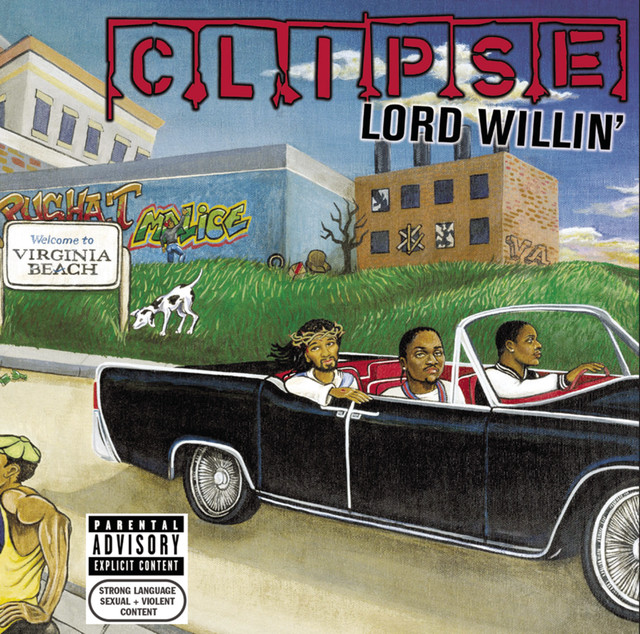
A Look Back At: Clipse - Lord Willin'

orangetrain

Sometimes an easy way to understand an artists progression is through their album artwork. In two years and three albums 2Pac went from restrained and reflective on the cover of Me Against the World; brooding and proud on All Eyez On Me; and strung from a cross, martyred on his posthumous album The Don Killuminati: The 7 Day Theory. It’s an ice-clear example of the artistic and personal progression Pac rapidly underwent in this space of time, reflecting the searing highs and lows his life bounced between, before his tragic death. 

Another ice-clear example of artistic progression and change as reflected in their artwork is Virginia’s favourite brother-rapper duo Clipse, who 15 years ago released their classic debut Lord Willin’. The hand drawn, highly stylised cover is reminiscent of Snoop Dogg’s classic Doggystyle, it exudes cockiness and swagger with Pusha and Malice riding in a Cadillac with Jesus in the backseat. In the background a sign proudly displays their hometown, Virginia Beach – a prominent theme on the album - , as well as some hints towards the social realities of the area, with the two brothers contrasted against the dilapidated buildings behind them. It’s a far cry from the dead-eyed stares, crowned in front of a wall of money with nothing but an oven and a stove pot, that defines their second classic album Hell Hath No Fury. The music of Lord Willin’ is a far cry from HHNF as well, it’s the swagger and lyrical style of Jay-Z and Biggie with a Southern twist, compared to HHNF’s Prodigy and Scarface imbued violence and paranoia. It’s an album with a youthful vigour, without another four years of industry bullshit to weigh them down, without the encroaching religious conscience of Malice and without the even further encroaching fear of the DEA. 

This sense of a youthful playfulness is emblematised perfectly by The Neptunes production, which is full of playful trumpet loops, their signature piercing drums, soulful samples, Pharell’s infectious hooks and funky bass lines– it’s music to dance to; it’s hard not to find yourself grooving to Grindin’, Young Boy or Ma, I Don’t Love Her without ever planning to. For an album whose predominant theme is selling coke, it’s a roaring testament to the timeless quality of The Neptunes that Clipse were able to stretch across genre appeal – Justin Timberlake’s Grammy nominated Like I Love You being the defining moment of this. Some beats feel a little dated now, FamLay Freestyle and I’m Not You are weak moments, the heaviness of the electronic influence leaving little to be desired, but they’re not helped by consistently weak features throughout. If the album suffers from any weak points it is the features, that lack the wittiness of Pusha and Malice, and as such just feel like they’re taking up space that one of the two MCs could better fill on their own. The astonishing skill of Clipse lies in the perfect balance between Pusha and Malice, who mirror and work off of each other so perfectly that other MCs tend to feel like they’re spoiling the broth. 

On Young Boy Pusha and Malice share memories of growing up in Virginia, practicing “gangsta leans” at thirteen, witnessing coke being cooked at four, how their grandma was a woman not to be messed with. For a Conservative right-wing pundit, the stories told might be a horror story, the racist terrors of growing up poor and black. For Clipse, with the help of The Neptunes’ up tempo beat, these are fond memories, touchstones of their youth – perhaps not a ‘normal’ youth, but theirs nonetheless. On When the Last Time the boys boast about their exploits with women, Malice declaring “club nights…one of the reasons I love life” and Pusha ending the song defiantly – “I’m a winner, man”. Pusha declares himself a king in two games at one point on the album, and the sentiment rings true. After nearly a decade of record label struggle, these two brothers would catapult themselves to commercial and critical success, and it wouldn’t even be their only source of income (allegedly). If the album perhaps lacks a depth and variety of content, it’s difficult to hold it against them too much – Clipse came out the gates with a celebration lap; the confidence and delivery in their own self-worth is infectious, you can’t help but like them. 

Those dilapidated buildings that point to a degree of social realism are lightly alluded to on the track Virginia, which acts in a similar vein to the palate cleansing Murder Was Tha Case on Snoop’s classic debut. The hook reveals a bleak lack of opportunity in the community, Pusha bluntly explaining that “I’m from Virginia, where ain’t shit to do but cook”. Pusha seems to straddle the line between confidence and insecurity on the track, “Lost it all, from lives to love/But my faith and money helped me rise above”. The lifestyle that he owes so much of his success to, and so much of his confidence and swagger on the album, slowly starts to crack before the listeners eyes. Yet, Pusha and Malice are always in strict control of how much of their inner self they wish to reveal. The line, “I miss you Shampoo, We miss you Shampoo” offers a glimpse of emotional honesty otherwise absent on the album, before Pusha snatches it away with his wry sense of humour by following it up with “And your grams too…”. Malice’s verse similarly is slightly more autobiographical than elsewhere on the album, but he pulls back even harder when the armour starts to slip – “what I look like spending my nights in jail,/ I could never be a thug they don’t dress this well”. We can forgive him though, because he ends his verse with two of the hardest bars ever spit. In a month where various fascist and neo-Nazi groups have rallied against the removal of Confederate monuments, Malice offers a wonderfully ironic ode to the racist history of the American South. If you don’t know it, go and listen now. 

Lord Willin’ is an interesting album on reflection. It’s full of witty punchlines, clever metaphors, hard bars and braggadocio delivery, and The Neptunes offer a wonderful contrast with their upbeat, funky and soulful production playing off against their lyrical content. At times the album can feel a little sparse on content, that ferociousness they unleash on HHNF is still waiting to boil over, and their structure and penmanship still has a way to go. But what HHNF has in its unrivalled lyricism and thematic coherence, Lord Willin’ has in its Souther swagger, its gangsta lean that leaves you with a smile on your face and a tap in your step when you throw the album on and take a trip down memory lane. Each Clipse album, and each Pusha and Malice solo project, operates within a unique space in time – the two brothers wear there emotional state on their sleeves; with Lord Willin’ they were on top of the world – and sometimes happiness, confidence, swagger and so on is good, sometimes it can imbue its readers with this state of mind too. In the troubled waters that lie ahead for 2017, I think we could all do with a little more confidence and swagger. 


Friday, 16 September 2016

Exploiting, Shaming and Saving: The Recurring Presentations of Sex Workers in Hip-Hop

orangetrain
This summary is not available. Please click here to view the post.

Monday, 5 September 2016

A guide (of sorts) to Bushwick Bill

orangetrain


Born December 8th 1966 in Jamaica, Bushwick ‘Richard Stephen Shaw’ Bill is a Jamaican-American rapper who rose to prominence in the late 80s and early 90s as part of the rap group Geto Boys. A central figure in the Houston rap scene, Bushwick and the Geto Boys helped put Southern hip-hop on the map, paving the way for entire new generations of MCs. Overshadowed by his fellow Geto Boys member Scarface, Bushwick is an important figure in rap history in his influence on Southern, gangsta and horror-core rap, who since the dawn of the 21st century has struggled to maintain the same importance and reverence that I feel he deserves from rap fans. The Geto Boys are a legendary group, essential listening for any hip-hop fan, with multiple classic albums, and Bushwick is the only member to remain since the groups first reformation in 1988 – admittedly he was only a hype man and dancer on the first album, but he would come into his own in the group with subsequent releases.
Interviews with Bushwick reveal some absurd stories from his life, including the now famous cover of We Can’t Be Stopped, which sees Bushwick being pushed through hospital by Scarface and Willie D after he had attempted to kill himself. The background to this story is that Bushwick forced his own girlfriend to shoot him in the eye by threatening to hurt their child so he could claim insurance money to help his mother; he even awoke in the morgue after doctors had declared him dead, now blind in one eye. He covers this event on his album Little Big Man in the song ‘Ever So Clear’.
Bushwick’s early solo albums are also impressive, the rapper tackling heavy themes of depression, suicide, and American politics, alongside his trademark gangster and horror-core blend of rap. His output has continued to persist into the 21st century, if lacking the same relevancy he achieved in the 80s and 90s, but his dedication to the rap game has not dwindled. This guide aims to look at the essential works of Bushwick Bill, to shine insight onto an oft-forgotten MC who is a masterful storyteller, able to intertwine comedy, tragedy and horror with the deftest of touch. 


 Making Trouble (1988)

Critically panned and a commercial failure, the Geto Boys’ first album barely received any attention at the time of release, with the resulting changes to the group that occurred because of the disappointing reception leaving this record to be largely forgotten. Bushwick Bill does not feature until the final track, and even then he is only given a small speaking role – perhaps if the MC had been given more opportunities to rap the album wouldn’t have been such a failure, but then perhaps this would have stopped the later classics that were released? For what it’s worth, ‘Assassins’ has been called the first ever horror-core track, and ‘Why do we live this way?’ stills hold up today – the verses are reasonably basic, but the production carries the track, including a fantastic jazz-solo at the end over the beat. The album is by no means essential, but could be an interesting listen for fans interested in the history of the Geto Boys and Southern rap in general.


Grip It! On That Other Level (1989)

With the failure of Making Trouble, Scarface and Willie D were brought into the group, and the Geto Boys that we know and love today was born. Grip It! has been compared to Straight Outta Compton for its controversial, politically charged and shocking lyrics, and whilst it’s impact and influence was not as far reaching as the seminal NWA classic, it’s still an exceptional record. The production is very much of the period and may be off putting for new listeners unaccustomed with the Geto Boys’ sound, but it’s a fitting backdrop for the newly formed group, complimenting their blunt and brutal sound. Willie D and Scarface (then going as DJ Akshen) dominate the record, with Face’s flow and persona quite different to the artist he would transform into on follow up records. As for Bushwick, of the three MCs he’s given the least to do on the record, but when he does rap, he shines. ‘Size Ain’t Shit’ is all Bushwick, a hilarious track that sees Bushwick explain how easily he’ll fuck you up and please your woman if you take his size for granted. On ‘Trigga-Happy Nigga’ Bushwick brilliantly tells the story of a liquor store robbery, before rounding out the album on ‘Mind of a Lunatic’ with one of the most shocking, horrific stories verses ever laid on wax. I won’t spoil the content of it, because if you haven’t heard it you need to now; needless to say before Tyler, The Creator, Eminem or Big L there was Bushwick Bill and he was making everyone else look tame.


We Can’t Be Stopped (1991)

The follow up album to Grip It!, We Can’t Be Stopped is another essential album in the pantheon of Southern hip-hop, taking the core shock-rap the group made their name on and venturing deeper into the politics of it. The opening title track sees Willie D and Bushwick trading bars over their previous album, calling out the racist hypocrisy of major label Geffen Records, and the failure of the media to report the ugly reality of being black in America. The rest of the album follows in a similar fashion, the Boys saying what they feel and not apologising for it, and whilst sometimes this can make for uncomfortable listening, particularly in regards to the misogyny present throughout, it’s unsurprising for a group that tried to push the boundaries of what you can and can’t say. The album is best when it’s not trying to immediately shock for the sake of it, such tracks as ‘I Ain’t With Being Broke’ earnestly tackling poverty, and Bushwick’s solo track ‘Fuck A War’ ripping to shreds the United States military, which includes one of rap’s best intro skits. The delivery across the album from all three MCs is fast, angry and blunt, and the production holds up far better than Grip It!. It’s an album that’s a shock to the system and Bushwick, Scarface and Willie D are all on top form weaving politics, shock rap, storytelling and bleak comedy to form their unique sound. Finally, of course, the album includes ‘Mind Playing Tricks On Me’; the Geto Boys’ haunting, intoxicating tale of drug infused paranoia and violence. Simply one of the best songs ever made.


Little Big Man (1992)

Bushwick Bill’s first solo album is a fun, silly and solid effort. It’s far from a classic album or even essential, but fans of Bushwick and the Geto Boys will certainly enjoy it. There are some great hyped up tracks, including the titular ‘Little Big Man’ and ‘Call Me Crazy’, the latter of which has a really wild, enjoyable hook to rap along to. The production is fairly standard early 90s, but it holds up quite well, dominated by strong drums and basslines, with some funky and soulful samples laced throughout for good measure to break up the potential monotony of it. Bushwick covers his usual topics, including his relationships with women, his height difference and his crazier side; all of which are tackled in his juxtaposed style of black comedy. ‘Ever So Clear’ is the stand out track on the album, the most personal song that explains the story of how he lost his eye and the famous cover of the Geto Boys’ We Can’t Be Stopped album. The production on this track has underlying tender beauty to it, complimenting Bushwick’s honesty about his impoverished background, physical disabilities, depression, paranoia and other personal tragedies that is difficult to listen to, providing a new insight into the psychotic, gangster persona that is normally fronted. This sort of deeply intimate and personal track is indicative of Bushwick’s importance at the forefront of rap, willing to open his soul to the listener long before this became the norm.

  
Till Death Do Us Part (1993)

Bringing in Big Mike to replace the recently departed Willie D, the Geto Boys’ fourth album is a safe, solid effort in their already strong catalogue. Offering the cleanest production of their albums up until this point; a steady Southern boom bap laced with funky basslines, but it ultimately lacks the abrasiveness of their first few efforts, reflecting a lack of energy throughout the album. Scarface steps up as the main MC on the album, however, and he is impressive throughout, especially on tracks like ‘Street Life’ and ‘It Ain’t’ – setting the stage for his classic solo release The Diary a year later. Outside of Face, Bushwick and Big Mike are unimpressive, trading basic rhymes about the gangsta rap lifestyle, without any of the forced shock of their previous efforts. There’s very little to fall in love with or hate about this album, it’s simply a safe effort and it’s clear that the change in group dynamic put the Boys on the back pedal. This is a nice album if you’re in the mood for some mindless Southern hip hop, but it’s far from the best Bushwick and the Geto Boys have to offer.


Phantom of the Rapra (1995)

Returning to another solo album, Bushwick released the excellent Phantom of the Rapra, and I’ve often felt it acts as a companion piece of sorts to 2Pac’s classic 1995 album Me Against The World. I don’t think anyone is going to argue that this album is better than MATW, but if you’re in the mood for more brooding, dark, angry and emotionally raw music then Phantom of the Rapra is certainly worth a listen. Bushwick’s style is honed and refined on this album, flowing with a relaxed Southern drawl that sees him ride the beat as well as he has ever done in his career. He’s rapping near his peak on this album, carrying it with barely any features, and packing in an enormous breadth of content. The concept of an opera x rap crossover is an interesting one, and at times Bushwick truly embraces the performative nature of both genres, rapping as though he’s the last man on earth – a crazed messenger for the end of the world. Tracks like ‘Wha Cha Gonna Do?’, ‘Times Is Hard’ and ‘Only God Knows’ are brilliant, painful listening; ‘Who’s the Biggest?’ and ‘Subliminal Criminal’ are angry, posturing tracks; and the final track ‘Mr. President’ is a first amendment address attacking the hypocrisy in blaming the rap game for violent crime, with some fantastic synth filled production. The second half of the album undoubtedly is weaker than the first, ‘Inhale Exhale’ and ‘The Bushwicken’ are forgettable, and it can’t quite capture the cutthroat honesty of the first half. Ultimately, on this record Bushwick hones his craft as a rapper, pushing his boundaries in terms of concept albums, but still grappling with the themes that have defined his career until this point. Bushwick has never been a particularly nuanced or subtle MC, but when he’s on point he can cut right to the core of the listener as well as anyone else.


The Resurrection (1996)

The aptly titled fifth Geto Boys album sees the return of the most beloved three members: Scarface, Bushwick Bill, and Willie D. With production led by Mike Dean (of Kanye West collaborator fame), The Resurrection is arguably a Southern classic. Dean heralds the production on the album alongside N.O. JOE and Scarface, lending The Resurrection far better longevity than any of their other albums. Soul samples, funky basslines and a general sound that oozes Southern rap makes this feel like their most mature album. Largely gone are the pure-shock raps from their previous albums, instead the album switches back and forth between gangster rap and hard-hitting political songs. It perhaps feels less like a Geto Boys’ album because Scarface takes the lead on verses, and whilst he is clearly the most gifted member of the three, Bushwick and Willie D do feel somewhat side-lined. Bushwick’s verses are few and far between, but they’re really strong throughout; ‘The World Is a Ghetto’, ‘Time Taker’ and ‘I Just Wanna Die’ are brilliant, open-hearted tracks, with Bushwick continuing to follow on from his style in Phantom of the Rapra. There are a handful of good features throughout, including members of FACEMOB and Menace Clan, but the album is strongest when the three members are on the track together. At this point in time if you don’t like the Geto Boys, you probably won’t like this album, but on The Resurrection the Geto Boys refined their style to its peak, offering an ode to the South and Southern rap in general that stands the test of time.


Concluding Thoughts

If this guide seems somewhat short it’s because it is. There are already seven Bushwick Bill albums that I have recommended to varying degrees, and more than an enough content to get to grips with and become a fan of, despite his lofty career after 1996. In a matter of seven years Bushwick Bill was involved in seven original albums, as well as a remix of Grip It! that came out in 1990. Essentially releasing a new album every year, Bushwick not only has the quantity but also the quality, pioneering Southern hip hop with the Geto Boys and releasing three classic albums in this period. Whilst his solo albums have never quite reached the lofty heights of his work with the Geto Boys, there’s still a lot to be enjoyed, and in his heart-wrenching lyrical honesty Bushwick was at the forefront of brutally autobiographical rap, the likes of which 2pac, Nas and Scarface made a career out of. A legendary MC who has arguably been forgotten with time, emphasised by the fact that the Geto Boys were unsuccessful in Kickstarting an album recently, I hope that this guide sheds some light on Bushwick Bill and the Geto Boys, and encourages more people to give his and their work a chance.